
Have you ever abandoned a recipe halfway through because you couldn’t figure out the measurements? You’re not alone. A missing unit conversion calculator has ruined more dinners than burnt toast. Whether you’re following a family recipe from Europe or a trending bake from Australia, having a reliable unit conversion calculator at your fingertips transforms frustration into kitchen joy.
🍳 Stop Guessing, Start Cooking with Confidence
One of the most common pain points for home bakers is the dreaded grams to cups baking conversion. A recipe that calls for 120g of flour means nothing if your measuring cups are all you have. That’s why mastering the grams to cups baking conversion is the single most important skill for consistent, delicious results. No more dense cakes or crumbly cookies—just perfect bakes, every time.
📌 In this guide, you’ll get:
- An interactive unit conversion calculator (works instantly!)
- Temperature conversions for any oven
- Travel tips for cooking around the world
No More Mistakes! Unit Conversion Calculator for Accurate Results
Whether you’re a seasoned chef or a home cook, we’ve all been there—struggling to convert measurements for a recipe that uses unfamiliar units. One cup to grams, tablespoons to milliliters, or converting ounces into teaspoons can quickly become confusing! Cooking should be enjoyable, not stressful. That’s why having a reliable cooking measurements conversion chart is vital to success in the kitchen.
With this ultimate cooking conversion guide, you can whip up any recipe without second-guessing, ensuring that your meals turn out perfectly every time. Let’s explore why you need a conversion chart and some common cooking measurement conversions.
Why a Cooking Conversion Chart Is Essential
Cooking is often referred to as both an art and a science. While creativity is encouraged in the kitchen, precision is key in measurements—especially in baking, where even slight variations can lead to a recipe disaster. The wrong measurement can lead to undercooked or overcooked dishes, too much sweetness, or too much salt, ruining the final product.
With a conversion chart on hand, you can easily switch between metric and imperial systems, making it possible to recreate recipes from all over the world. Whether you're converting grams to ounces or cups to milliliters, an online calculator for cooking measurements takes the guesswork out of the process and ensures your recipes are accurate and consistent every time.
For international recipes especially, keeping an online calculator for cooking measurements bookmarked means you're never stuck mid-recipe trying to do the math by hand—just enter the value and get an instant, reliable conversion.
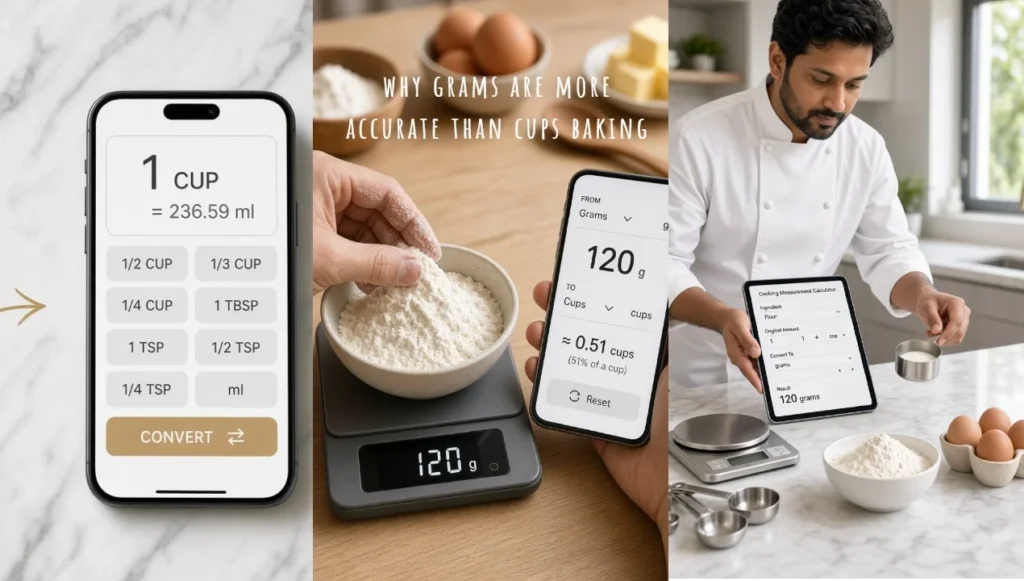
Why Precision Matters in the Kitchen – Unit Conversion Calculator
Accuracy measurements are essential, especially for baking, where ingredient ratios are crucial to success. For example, too much flour can dense your baked goods, while too little liquid can dry them. Precision in your ingredient measurements helps ensure that the flavors and textures are balanced, leading to better and more consistent results every time.
Similarly, the same recipe made in different regions often uses different measuring units. A recipe from the UK might list ingredients in grams, while an American recipe will use cups and ounces. A conversion chart helps bridge the gap between these systems, making it easier for you to try recipes from various cuisines around the globe.
How to Use the Interactive Unit Conversion Calculator
Choose a conversion type
Select from the dropdown menu (grams to ounces, cups to ml, Celsius to Fahrenheit, etc.)
Enter your value
Type any number (e.g., 250, 0.75, 16) in the input field
Get instant results
The conversion appears immediately — no buttons to click or pages to reload
⚖️ Interactive Unit Conversion Calculator
Select a conversion type, enter your value, and get an instant answer.

✈️ Cooking Around the World: Understanding Local Measurements
When you travel and take a cooking class in another country, you'll encounter different measurement systems. Here's what to expect:
- 🇺🇸 United States: Uses cups, tablespoons, teaspoons, ounces, and Fahrenheit.
- 🇪🇺 Europe (most countries): Uses grams, milliliters, liters, and Celsius.
- 🇬🇧 United Kingdom: Mixes metric (grams) with imperial (pints, ounces).
- 🇦🇺 Australia: Uses metric but has a unique tablespoon (20ml vs 15ml).
- 🇯🇵 Japan: Uses grams and milliliters, plus traditional "go" for rice (180ml).
💡 Travel Tip: Save this page on your phone before your next trip. You'll be able to shop at local markets and follow regional recipes with confidence.
Baking & Liquid Measurement Conversion: FAQ
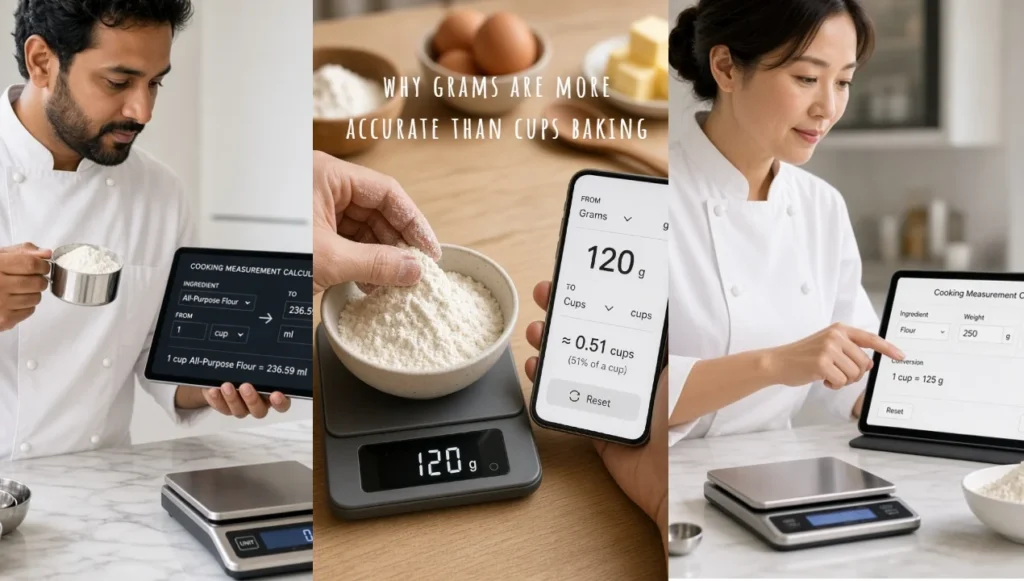
One cup of all-purpose flour is approximately 120 grams. This can vary slightly depending on whether the flour is scooped or spooned into the cup — spooning and leveling gives a more consistent result.
One cup of granulated sugar weighs about 200 grams. Brown sugar is slightly heavier when packed, typically closer to 220 grams per cup.
One cup of butter is approximately 227 grams — this is a fixed conversion since butter is typically sold and measured by weight already, even in US recipes.
One US cup of liquid (water, milk, oil) equals approximately 240 milliliters. Unlike dry ingredients, liquids have a consistent density, so this conversion stays accurate across most recipes regardless of the specific liquid used.
A US tablespoon is about 15 milliliters, and a teaspoon is about 5 milliliters. Note that UK and Australian tablespoons are larger (20ml), so it's worth checking which standard a recipe is using before converting.
Grams measure weight, while cups measure volume — and volume can vary depending on how an ingredient is packed, scooped, or settled. This mainly affects dry ingredients like flour and sugar; liquids are more forgiving since they naturally settle to fill a measuring cup evenly. This is why professional bakers and European recipes rely on weight-based measurements for dry ingredients, while liquids are commonly measured by volume even in metric recipes.
To convert a baking recipe from grams to cups, divide the gram amount by the weight of one cup of that specific ingredient (for example, 120g for flour or 200g for sugar). Since each dry ingredient has a different density, there's no single universal conversion — it's best to convert ingredient by ingredient using a dedicated chart or calculator. Liquid ingredients are simpler, since grams and milliliters are roughly equivalent for water-based liquids.
Most European countries use the metric system as standard, so traditional recipes are written in grams rather than cups — including liquids, which are often listed in milliliters instead of cups or fluid ounces. When adapting a European recipe for a US kitchen, a grams-to-cups conversion is often necessary — but because dry ingredient density varies, it's more reliable to weigh those directly if you have a kitchen scale on hand.
📢 Did this conversion tool help you?
Share your experience in the comments below — tell us which conversion you use most often!
💬 Leave a commentJoin the Conversation

April 6, 2026 at 2:21 pmHaving a reliable converter for grams to ounces (and Celsius to Fahrenheit for the oven!) makes a huge difference in getting the texture just right. Thanks for sharing!
May 1, 2026 at 2:50 amWhen traveling abroad, I’ve found that shoe sizes are the trickiest to convert on the fly. I keep a screenshot of a conversion tool on my phone now so I don’t have to hunt for Wi-Fi in a boutique
May 4, 2026 at 7:18 amI learned the hard way in Saigon that a ‘Large’ in Vietnam is very different from a ‘Large’ in the US! I always recommend using a conversion tool before shopping abroad to avoid that holiday heartbreak when you get back to the hotel.
May 5, 2026 at 3:58 amI recently used a digital conversion chart for a trip to Europe and it saved me so much suitcase space because I didn’t have to bring ‘just in case’ backups
May 15, 2026 at 3:30 pmI think that you could do with some pics to drive the message home a little bit, but instead of that, this is excellent blog. A fantastic read. I’ll certainly be back.